Exterior Paint Calculator 2026 – How Much Paint for House Exterior Worldwide (Weather Tips Included)
By Paint Pro Calc Team
Calculate exterior paint quantities for any house size worldwide. Includes weather tips, surface type guides, and cost breakdowns for US, UK, Australia, and NZ.
Exterior Paint Calculator 2026 – How Much Paint for House Exterior Worldwide

Painting the exterior of a house is one of the most impactful improvements you can make — it protects the structure, boosts curb appeal, and can add significant value to the property. But exterior painting is also where overbuying or underbuying paint is most expensive.
This guide covers everything you need to calculate exterior paint accurately in 2026, including surface types, climate considerations, and worldwide cost benchmarks.
Exterior vs Interior: Why Calculations Are Different
Exterior painting is significantly more complex than interior painting for several reasons:
1. Surface variety — You may be painting weatherboard, brick, render, fibre cement, timber, or metal. Each has a different coverage rate.
2. Weather exposure — Exterior paint must handle UV, rain, frost, and heat. Quality matters more outdoors.
3. Substrate condition — Old, flaking paint requires more preparation and often extra primer coats.
4. Irregular surfaces — Weatherboard, shingles, and rough render absorb significantly more paint than smooth interior walls.
Coverage Rates by Surface Type
| Surface | Coverage Rate (m²/L) |
|---|---|
| Smooth render / plaster | 10–12 |
| Rough textured render | 6–8 |
| Weatherboard / timber | 8–10 |
| Brick (painted) | 8–10 |
| Brick (unpainted / porous) | 4–6 |
| Fibre cement / Hardie | 10–12 |
| Metal (primed) | 10–14 |
Always check the technical data sheet of your specific paint for the manufacturer's stated coverage rate.
How to Measure Your House Exterior
Step 1: Calculate wall area
Measure the perimeter of your house and multiply by the wall height.
Example: House is 12m × 9m, walls are 3m high to eaves. Perimeter = (12 + 9) × 2 = 42m Wall area = 42 × 3 = 126m²
Step 2: Deduct openings
Count windows and doors:
- Each standard window ≈ 1.5m²
- Each standard door ≈ 2m²
- Garage door ≈ 8m²
Example: 8 windows + 2 doors + 1 garage = 12 + 4 + 8 = 24m² Net wall area = 126 − 24 = 102m²
Step 3: Add gable ends
If your house has a pitched roof, calculate the gable triangles: Gable area = (width × height) ÷ 2
Example: 9m wide gable, 2m high = 9 × 2 ÷ 2 = 9m² × 2 gables = 18m²
Total exterior area = 102 + 18 = 120m²
Calculating Paint Quantity
Using our example (120m², weatherboard surface, 2 coats):
Paint needed = (120m² × 2 coats) ÷ 9 m²/L = 26.7L
Add 10% buffer = 29.3L → buy 30L
For a second colour on trim and fascia, calculate that separately using a higher-coverage gloss paint.
Number of Coats: A Practical Guide
| Situation | Coats Needed |
|---|---|
| Same colour, good condition | 1–2 |
| Colour change, light to dark | 2 |
| Colour change, dark to light | 2–3 |
| Previously unpainted surface | 1 primer + 2 topcoats |
| Severely weathered / chalking | 1 sealer + 2 topcoats |
Weather Tips by Region

🇺🇸 United States
Best painting season: Spring (April–June) and Fall (September–October) in most regions.
- Hot climates (Texas, Arizona, Florida): Paint dries fast — great for productivity, but watch for bubbling if applied in direct midday sun. Start early morning.
- Cold climates (Minnesota, New England): Never paint below 10°C (50°F). Water-based paints can fail in cold temperatures.
- Humid climates (Southeast): Ensure surfaces are completely dry before painting. Use mould-resistant paint additives.
- Coastal areas: Use alkyd or 100% acrylic paints with salt-resistance properties.
🇬🇧 United Kingdom
Best painting season: May through August (drier, warmer).
- The UK climate is generally cool and damp. Always check the 5-day forecast before starting an exterior job.
- Never paint if rain is expected within 24 hours or temperature drops below 8°C.
- Masonry paint is the standard exterior product for rendered walls, with good breathability for older buildings.
- Microporous paints work well on timber windows and doors to allow moisture movement.
🇦🇺 Australia
Best painting season: Autumn (March–May) and Spring (September–November).
- High UV environments (Queensland, NT): UV-resistant exterior paints are essential. Expect faster fade on cheaper paints.
- Bushfire zones: Check for ember-resistant paint recommendations in your area.
- Coastal areas: Salt-resistant paint is critical — standard exterior paint deteriorates rapidly near the ocean.
- Water-based acrylic exterior paints dominate the Australian market and perform well in most conditions.
🇳🇿 New Zealand
Best painting season: November through March (summer).
- NZ has high UV levels year-round — don't skimp on UV-resistant exterior paint even in the South Island.
- Wellington: High wind exposure means good adhesion and flexibility are critical. Use premium acrylic.
- Auckland: High humidity — allow full dry time between coats and use mould-resistant formulations.
- Christchurch: Temperature fluctuations in Canterbury mean flexible, crack-resistant paint is important.
Worldwide Cost Benchmarks: Exterior Paint Job (120m²)
| Country | Paint Cost | Labour | Total Estimate |
|---|---|---|---|
| USA | $480–$960 | $1,800–$4,200 | $2,280–$5,160 |
| UK | £300–£600 | £900–£2,400 | £1,200–£3,000 |
| Australia | $600–$1,200 AUD | $1,500–$3,600 AUD | $2,100–$4,800 AUD |
| New Zealand | $700–$1,400 NZD | $1,800–$4,200 NZD | $2,500–$5,600 NZD |
These are indicative ranges. Prices vary significantly by location, paint brand, and contractor rates.
Exterior Paint Types: Which to Choose?
100% Acrylic Latex — The gold standard for most exterior surfaces. Flexible, UV-resistant, breathable. Suitable for most climates worldwide.
Masonry Paint — Specifically formulated for brick, render, and concrete. High build formulas fill hairline cracks.
Oil-Based / Alkyd — Harder finish, excellent adhesion. Good for metal and timber trim. Longer dry time, solvent clean-up.
Elastomeric Paint — Ultra-flexible, waterproofing properties. Ideal for cracked render or concrete block in wet climates.
Specialty Coatings — Anti-fungal, heat-reflective, anti-graffiti, or ember-resistant coatings for specific applications.
Use the Free Exterior Paint Calculator
Stop guessing. Enter your house dimensions into Paint Pro Calc and get:
- Exact litres needed for your specific surface type
- Cost estimate based on current paint prices
- Suggested quote price if you're a contractor
- PDF quote ready to send to your client
→ Calculate Exterior Paint Free
Contractor Tip: Quote Exterior Jobs with Confidence
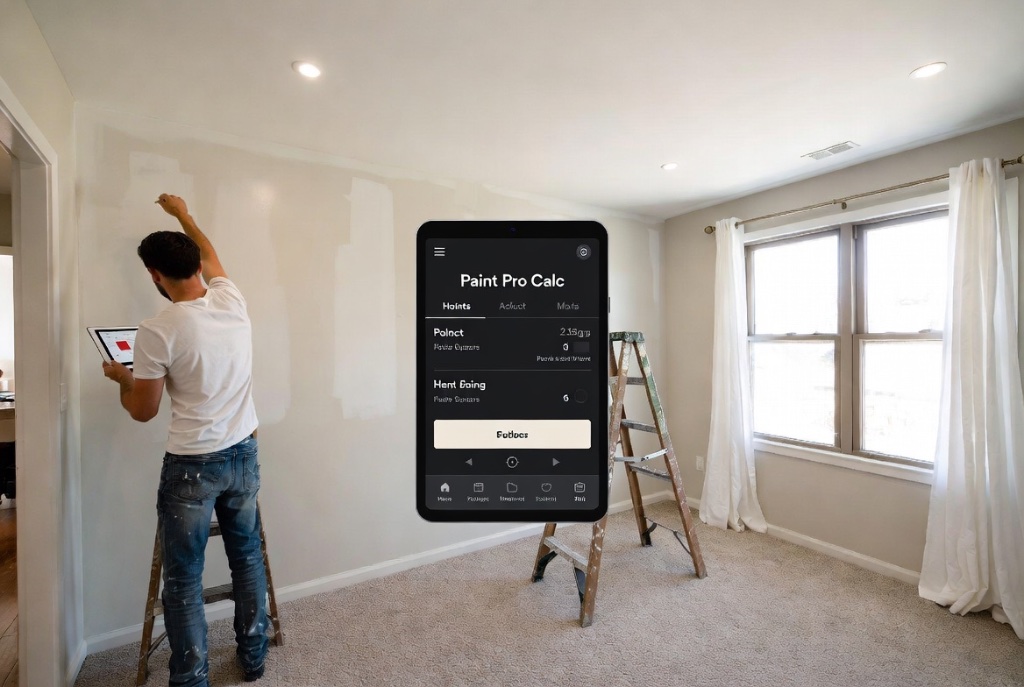
Exterior jobs are often higher value than interior work — and clients expect a professional quote. Paint Pro Calc Pro generates a branded PDF quote you can email directly from your phone on the job site.
With Pro you also get:
- Profit tracking — see your actual margin once the job is complete
- Client records — all contact details and job history in one place
- Invoice generator — turn any quote into an invoice in one click
$2.99/month. 7-day free trial. No credit card required.
Summary: Exterior Paint Calculator Checklist
✅ Measure all wall surfaces (including gable ends) ✅ Deduct all doors, windows, and garage doors ✅ Choose the right paint for your surface type ✅ Check weather forecasts before starting ✅ Use the correct coverage rate for your surface ✅ Add 10% buffer to your total ✅ Calculate primer separately if needed ✅ Use Paint Pro Calc to get the full cost breakdown
Ready to calculate? Start free at paintprocalc.com